Ask anyone in Florence who invented gelato and the answer comes without a moment of hesitation: we did. Or, to be precise, a man named Bernardo Buontalenti.
It’s a story Florentines love to tell, often while waiting for their cone, and I’ll tell it to you too, because it’s part of local culture and it would be a shame to skip it. But I’m a guide, not a mere storyteller, so I went to check the documents and historical sources, and here’s how things really stand with the dates.
Who invented gelato? The story Florence tells
The legend sets the invention in Florence in the mid-1500s, under the Medici, the family that ruled the city. A very important guest is about to arrive: Emperor Charles V. The Medici want to welcome him with celebrations so splendid that he’ll be left speechless (and, while they’re at it, well disposed toward their requests). The job goes to Buontalenti, the court’s Renaissance jack-of-all-trades: architect, stage designer, builder of machines and fireworks.
For the grand finale, he prepares a cream of eggs, honey, cream, milk and sugar, with a splash of wine. He makes an enormous batch and leaves it to chill in the ice cellars. And then, as geniuses do, he forgets all about it. When he finally goes back, the cream has frozen. Gelato is born, by absent-mindedness.
It is then Catherine de’ Medici who carries it across Europe. When she becomes Queen of France as the wife of Henry II, she brings Florentine pastry chefs to the French court, so her guests will never be without the new frozen cream.
An interesting, believable story. Perfect, really. Too bad about the dates…
When the numbers don’t add up
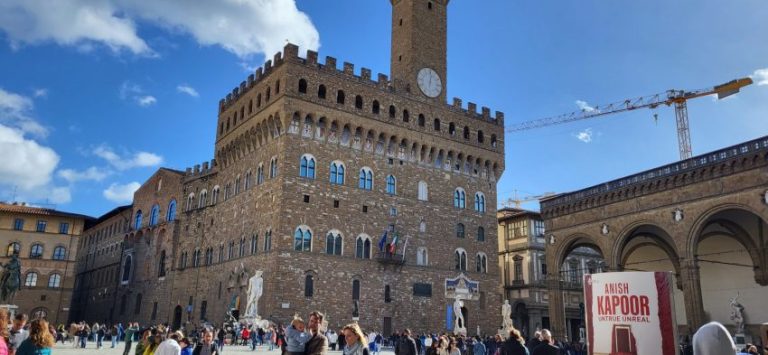
Charles V did come to Florence: he made his ceremonial entrance on 29 April 1536 and stayed until 4 May. To welcome him, the festive decorations were directed by Giorgio Vasari, the painter and architect, working with other artists. Buontalenti, born in December 1531, was four years old, an age better suited to eating gelato than inventing it. And Catherine had already left for France in 1533, when he wasn’t yet two.
Moreover, depending on who tells it, the guest turns into a Spanish delegation, and the banquet moves between Florence and the French court. Meanwhile, Buontalenti’s entry in the Dizionario Biografico degli Italiani, the national biographical dictionary published by Treccani, lists villas, fortresses, grottoes, stage sets and even a cannon called the “Scacciadiavoli” (“Devil-Chaser”, at least according to his early biographer Baldinucci). Gelato doesn’t get a single word.
The other contenders
Another, equally Florentine version prefers a different hero: a certain Ruggeri, a chicken seller turned cook, who supposedly won a Medici cooking contest with a frozen dessert and was taken to France by Catherine. “It is said,” writes Treccani, because no trace of his recipe has ever turned up. What we do know is that little frozen sweets were all the rage in Florence.
Then there’s Paris. In 1686 a Sicilian named Francesco Procopio dei Coltelli opened the Café Procope, which became one of the city’s most famous meeting places. Its menu, in Italian, offered iced waters (granita), lemon gelato and strawberry sorbet.
Even the word itself lacks historical backing: “gelato”, in the sense of something distinct from sorbet, first appears in a cookbook only in 1826.
Florence isn’t left empty-handed, though. The 1932 Enciclopedia Italiana thought it likely that the first gelati were made in Tuscany in the 1500s, with Florentine gelato makers among the first to produce it on a large scale. There may never have been a single inventor. But the idea was born early, and right around here.
The final twist
There’s one last curiosity, and it’s my favorite. The Crema Buontalenti you’ll find in every gelateria in Florence today doesn’t come from a Renaissance recipe book. It’s a twentieth-century flavor. Between the late 1960s and the early 1970s (the exact date is uncertain), the city’s gelato makers’ committee held a competition for a gelato dedicated to the architect, setting the ingredients: cream, milk, eggs and sugar. No honey, no wine. Who won? The records don’t say, and there’s no shortage of claimants.
So the tale of Buontalenti and the cream forgotten in the ice cellar remains a legend, but a lovely one, which Florence will keep telling with pleasure. The flavor that bears his name, on the other hand, is a tribute: Florence’s gelato makers dedicated it, centuries later, to a great fellow citizen. So the next time you order Crema Buontalenti (on the sign it may also read “crema fiorentina”), you can tell the story yourself, choosing whether to stick to the documented history or to entertain your travel companions with a nice legend.
This is just a taste. In my guide Do-it-yourself FLORENCE, I accompany you through a wonderful step-by-step tour to discover the city, telling you both legends and documented facts. Along our route, I point you to the gelaterie and restaurants I truly recommend. I also take you to the quieter side of Tuscany, with three day trips from Florence. The guide book comes with an audio guide: a QR code in the paperback and a link in the Kindle edition, so you can listen to the stories as you walk. Take a look inside Do-it-yourself FLORENCE.
If you’d like to check the sources:
Treccani (Italy’s national encyclopedia), Dizionario Biografico degli Italiani (entry on Buontalenti, 1972); Treccani, Enciclopedia Italiana (entry on Gelato, 1932); Treccani Magazine, “Gelato: una parola da imparare a leccare” (2022); Palazzo Medici Riccardi, “Visita di Carlo V” (1536).