The Yokai Exhibition in Florence is a beautiful exhibition that lasts from hot summer days until late autumn: you have until November 3, 2024, to enjoy this highly original exhibition of Japanese art and culture.
The location is also in itself an excellent reason to buy a ticket: the Yokai Exhibition is located in the museum of the Spedale degli Innocenti, designed by Filippo Brunelleschi, which is among the first Renaissance buildings in Florence.
TABLE OF CONTENTS
- What are Yokai?
- The Ritual of the 100 Candles of the Yokai Exhibition
- The exhibition itinerary at the Yokai Exhibition
- Armours at the Yokai Exhibition
- Contemporary art at the Yokai Exhibition
- The Yokai Exhibition: why not?
WHAT ARE YOKAI?
Yokai and Yurei are the monsters and spirits that have always been part of the Japanese cultural tradition, since the origins when stories were handed down orally.
In the seventeenth century, after a period of wars for power, the Edo era began in Japan, a period in which through the policy of the “closed country” (prohibition of entry to foreigners and prohibition of travelling abroad to the Japanese), political and social control and repression, peace and stability could be guaranteed for the next two hundred years.
Obviously, given the climate of repression, the Yokai and the Yurei proliferated in all the artistic and cultural productions of the eighteenth and nineteenth centuries, because they perfectly embodied the sensations, fears and social anxieties.
The Yokai Exhibition, through the display of more than one hundred and fifty works, including prints, books, masks, weapons and armor, offers a representation of that creative and fantastic world populated by the monsters of the Japanese tradition.
THE RITUAL OF THE 100 CANDLES OF THE YOKAI EXHIBITION
Whether you are a fan of Japanese art, a devourer of anime, a simple sympathizer or even a total stranger to this world, the Yokai Exhibition will involve you from the very first moment.
The exhibition begins with the Ritual of the 100 candles. This ritual was a legendary test of courage that the samurai underwent: after sunset, all the samurai would meet in a room lit by only 100 candles. Each samurai had to tell the others a story of fear, to scare them to death. The stories were therefore populated by monsters, precisely the Yokai. At the end of each story a candle was extinguished.
The Yokai Exhibition re-proposes this ritual: you enter a dark room illuminated by the light of 100 candles; the effect of the candles is then expanded and multiplied thanks to the use of mirrors. One by one the candles go out and each extinguishing is accompanied by the dark voice of the ghost of that samurai who died of madness, after meeting a real yokai monster.
THE EXHIBITION ITINERARY AT THE YOKAI EXHIBITION
After experiencing the ritual of the 100 candles, the experiential journey continues with the prints of the monsters. Even when viewing these works of art, the immersive experience in fear is not interrupted, because you are often surprised by the distant telling of stories of fear or by simple hoarse voices and sounds, which reproduce the climate of tension.
The Yokai Exhibition also makes us reflect on the fact that the aesthetics of monsters or grotesque representations has always been part of Japanese culture: since the beginning, these representations have had a certain priority in visual art and literature, perhaps because of their peculiarity of having a strong impact and emotionally involving the public.
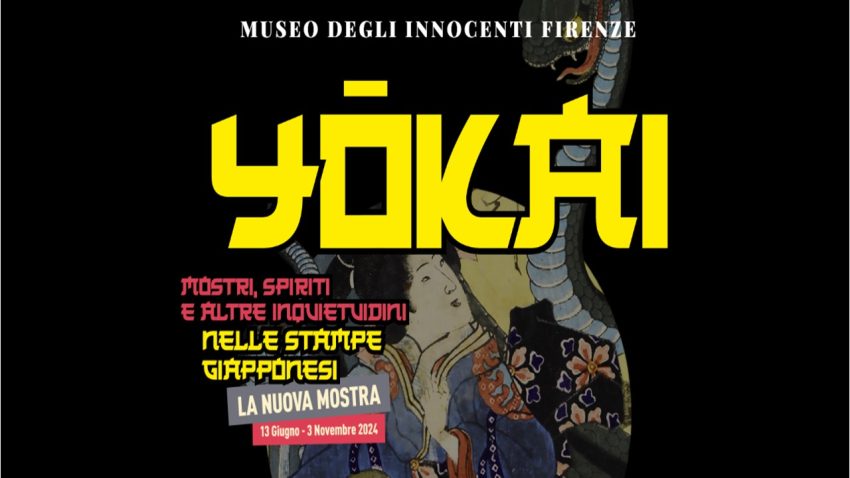
ARMOURS AT THE YOKAI EXHIBITION
On display are also the books that collect scary stories, monster masks and weapons, helmets, swords and armours that belonged to the noble samurai.
Super interesting are the armours (borrowed from the Stibbert Museum in Florence) that date back to an earlier period, the Sengoku jidai, that is, the period of bloody wars (fifteenth century), because in that period fear and death permeated the popular imagination so much that the warriors themselves, the samurai, were transformed into yokai.
The armours on display at the Yokai Exhibition have shapes inspired by the monstrous figures of the yokai of the folk tradition, as are the helmets and daggers.
CONTEMPORARY ART AT THE YOKAI EXHIBITION
The Yokai Exhibition, eventually, demonstrates how the aesthetics of fear, monsters and the grotesque that has characterized Japanese culture and art since its origins, continues to play a central role in artistic representations.
A selection of works created specifically for the occasion by the young artist Giulia Rosa, an illustrator with a large following, shows us the relevance of the graphic theme of monsters from which the author drew inspiration for the creation of the plates on display.
Finally, the Yokai Exhibition offers a series of materials including illustration and posters made for anime of the modern scene, among which, even the less experienced and up-to-date (like me) will recognize the protagonist of the Dragon Ball series.
THE YOKAI EXHIBITION: WHY NOT?
So, if you are in Florence or if you are organizing your weekend in Florence, (here are my suggestions of where to stay) with your teenage children (but also a little younger), this is the ideal exhibition to involve everyone and take a break from the immersion in Renaissance works of art, museums and cultural visits with which you will have filled your stay in Florence.