“How to say…” or “how to ask…” is one of the most recurring questions that go around your head, as part of your preparation to your upcoming travel to Italy. Of course, you know that nowadays English is spoken all over the world and if you are hitting the most famous tourist paths in Italy, you will be welcomed and attended by hospitality professionals who speak English quite fluently.
Just think how lucky you are and how easy the history has made travelling to you, in comparison to other people. I wish I could have expected hospitality professionals to speak Italian when I first travelled to the US. LOL. I had to struggle, instead, with my listening, unacquainted to the American accent. Ha.
Italians have been visited by tourists since the beginning of the past century. Maybe this is the reason why we are open to foreigners, very welcoming for nature and most of the time getting out of our way to make everyone feel at home. We love other people so much that can be defined as xenophiles.
It is a fact that we adore speaking English, and we don’t miss any occasion to do so, to the extent that, even if a foreigner speaks Italian perfectly, in the moment that we spot the accent, we switch to English. This has been the main obstacle to my Aussie hubby’s Italian learning process. No one would ever speak to him in Italian, despite he was. LOL
With this ease of mind, still don’t forget that English is your native language, while it is a foreign language for Italians, who are probably making more effort than you might imagine keeping the conversation fluent. With this in mind, and to be very well received travellers, please don’t demand that everyone speaks English and don’t complain if someone doesn’t.
You might find a taxi driver or a train employee or a market salesperson who doesn’t speak English and is not requested to for their job. Despite English being a spread and common language nowadays, you shouldn’t travel (anywhere not only to Italy) with the claim that everyone will understand you and speak your own language.
I’m not saying here that you need to attend a full course of Italian, but a few Italian words and phrases will go a long way and earn you a lot of gratitude and appeal among Italians. It is not only a question of knowing how to say things, but of course, you will need to know how and when to use the words and sentences, to avoid unwanted reactions, -like laughs most of the time.
I remember a Californian friend of mine telling me how disappointed she had been on her first contact with Italians, as she greeted them saying: “Buon pomeriggio” and people looking at her in a strange way almost laughing. She was wondering what was wrong and checked again on her translator how to say “good afternoon”.
How funny! This made me laugh a looooot. As you might expect, you can’t directly translate what you would say in your own language. In fact, this is the mistake number one, when studying a foreign language. You shouldn’t think in your language and translate into the foreign language but think directly in the foreign language.
In the specific case, my friend didn’t know that in Italy we normally don’t use the expression “Buon pomeriggio”, even if it exists and it’s grammatically correct, no Italian would ever greet other people saying “Buon pomeriggio”, especially in an informal situation, like the one she was on.
Oooops. This is scary, then. How can you prepare to your travel to Italy, where almost everyone speaks English, but not every-everyone and you can’t use the phrases that you find online as a direct translation? No need to worry, I have your back!
TABLE OF CONTENTS
- How to say… Greetings
- How to say… Introductions + meeting new people
- How to say… Thanking
- How to say… Apologizing
- How to say… Drinks
- How to say… Food
Here’s a list of easy expression with quick explanations for you to show off and sound like a real Italian during your wonderful experience in Italy.
HOW TO SAY… GREETINGS
Hello/Hi > Ciao
You all know this word but remember that Italian is a more formal language than English, so we wouldn’t use Ciaoevery time you use Hello/Hi. For example, we don’t say Ciaoto the employee at the train ticket desk, or to the bus driver, or the taxi driver. As a general rule, we don’t say Ciaoto anyone we don’t know well, unless they are minor. If you are an adult, and you meet a kid (0 to 17 y.o.), then you’ll say Ciao, but not the reverse (if you are a kid you won’t say Ciaoto an adult. It happens with little ones -3 to 7 y.o.- as they have not learnt the formal yet).
Good morning > Buongiorno
It literally means Good Day. This is the greeting form that we mostly use. It works well starting from the morning until around 4:00 pm (remember: we rarely use “buon pomeriggio” > “good afternoon” in normal occasions). We don’t have a form to translate your Good Morning (so, don’t try to make something up for it, LOL), we use Buongiorno in all those situations when you would say Good Morning but also Hi / Hello / Good Afternoon.
Good evening > Buonasera
It literally means Good Evening. After 4:00 pm we switch to Buonasera, and we use it in every occasion on which during the day we would say Buongiorno. Typically, you will enter a restaurant and say it or if you catch a taxi after 4:00 pm). This works until you go to bed. Careful: we don’t say Buonanotte (Good Night)unless we are really going to bed at that same moment.
Your receptionist at the hotel might tell youBuonanottewhen you go back from your night out, and you are going to bed, but it has to be very late. While you can say Buonaserain both situations: when you meet someone and when you are leaving, you cannot greet someone with Buonanottewhen you meet them, only when you leave, and it’s really late.
Goodbye/Bye > Arrivederci
It literally means See you. We can use it for both formal and informal situations, even if for informal situations, Ciaois much more common.
A little note here. When we say “Hello” to someone that is not family/friends (so, in situations that will happen to you during your travel to Italy) we don’t ask how you are; not because we don’t care, but because when we ask, we really mean it, we want to know how they are doing. Therefore, we don’t usually ask people that we don’t know well, because we would result intruding in their privacy.
For example, you won’t be asked how you are or how has been your day so far at the supermarket or at the cashier of a coffee shop. The first time I was asked when in the US, I remember thinking how rough it was, such a direct question without knowing me. And I was even more shocked when I realized that that person was not interested at all in my answer, and they were already busy with something else and not even looking at me right after asking. LOL
HOW TO SAY… INTRODUCTIONS + MEETING NEW PEOPLE
What’s your name? > Come ti chiami? (informal) or Come si chiama? (formal)
My name is… > Mi chiamo…
Nice to meet you > Piacere di conoscerti (informal) or Piacere di conoscerla (formal)
Where are you from? > Di dove sei (informal) or Di dove è? (formal)
I’m from … > Vengo da… / Sono
US > dagli Stati Uniti / Americano
Canada > dal Canada / Canadese
UK > dal Regno Unito / Inglese
Australia > dall’Australia / Australiano
HOW TO SAY… THANKING
Thank you > Grazie
Thank you very much > Grazie mille
You’re welcome > Prego
My pleasure > È un piacere
HOW TO SAY… APOLOGIZING
Excuse me > Scusa (informal) or Mi scusi / Scusi (formal)
I am sorry > Mi dispiace / Mi spiace
I apologize > Chiedo scusa / Mi scuso
A little note here. When we want to attract attention to ask for help or information, we use “Mi scusi“. When we accidentally bump into someone, we say “Mi scusi“. But don’t forget, we always keep in mind who is the person that we are talking to.
I remember a lady complaining about bad mannered Italian teenagers, as once she needed to pass them from behind on the side walk and to ask for space she said to a boy “Mi scusi”. Of course, the kids started laughing as by using the formal “Mi scusi” she was treating him like if he was an old gentleman.
So, always look at the person to whom you are referring to and if it is a child up to 17 y.o., just say the informal version that is simply “Scusa”.
In this case it was also funny as she didn’t use the right expression and the kid didn’t quite understand what she wanted. Most probably she just looked up “how to say excuse me” in Italian and the translation was literal, but not useful for her need. In fact, if you want to overtake or have space to walk in a crowded environment, you should say “Permesso”.
HOW TO SAY… DRINKS
Coffee (in a big mug and black) > Caffè Americano
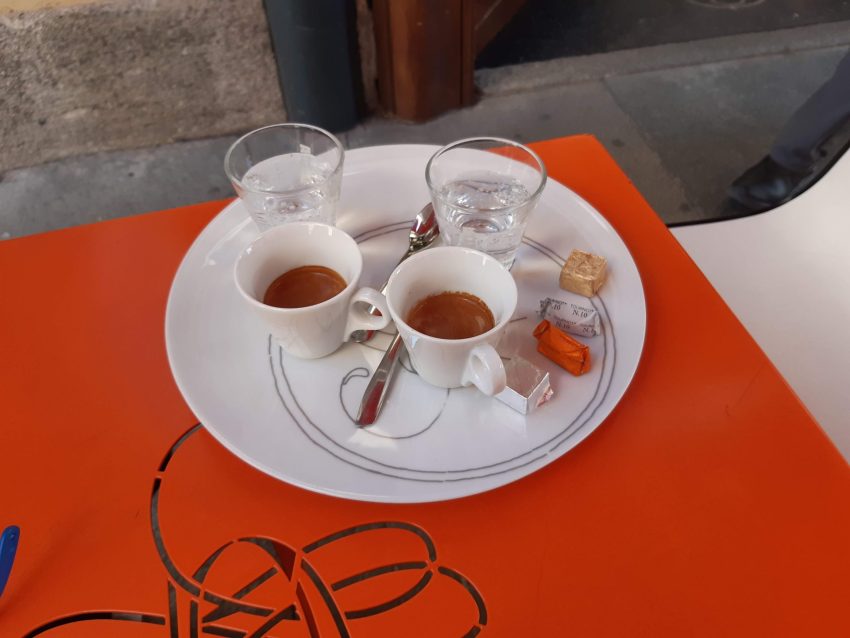
Espresso > Caffè
Of course, they will understand if you order an “espresso”, but just be aware that in here what you call “espresso” is the normal coffee we all drink, therefore we don’t use the word espresso; when ordering “un caffè” we get what you call “espresso”. If you order a “caffé” they might ask you “normale?” just to make sure that you don’t want a macchiato or any other type of coffee
Espresso slightly bigger than normal > Caffé lungo
Espresso slightly smaller than normal > Caffé ristretto
Espresso with a drop of cold milk > Caffè macchiato freddo
Espresso with a little foam of milk > Caffè macchiato caldo
A little note here. If you can’t drink caffeine you might want to order “un caffè d’orzo” or “un orzo” and you will get a coffee made of toasted barley in the little coffee cup. Not too bad, after all. Try it!
Latte > Caffè e latte / Caffelatte
A glass full of Milk and a drop of espresso > Latte macchiato
A little note here. In Italian “Latte” means “Milk“, white and without anything else. So, if you order a “Latte” you will get a full glass of milk (we normally order that for our kids).
Tea > té
Unless it is for breakfast, when the tea is obviously hot, if you order a “Té” in a bar you will always be asked if you want it “caldo” (hot) or “freddo” (cold). Also, we normally have tea with a drop of juice of squeezed lemon and sugar, while we never serve tea with milk, unless you specifically ask for it.
Water > Acqua
Plain / Sparkling Water > Acqua Naturale / Frizzante
A little note here. Please be aware that we normally don’t serve ice cubes with water, so if you really, really want it, try and ask for it. But, especially in the restaurants they might answer that they don’t have ice cubes. Cold water from the refrigerator is cold enough for us, we don’t need to add ice cubes. LOL!
Also, be aware that water is neither free nor automatically refilled in Italy. If you need more water you will have to ask for another bottle, and you will be charged for it.
Wine > Vino
Red / White / Rosé Wine > Vino Rosso / Bianco / Rosato or Rosé
Beer > Birra
Draft Beer > Birra alla Spina
A little note here: We have 2 sizes for the glass of beer:
“Birra Piccola” (translated Small Beer) which is 0.2-0.25 litre and
“Birra Media” (translated Medium Beer) which correspond to 0.4-0.5 litre, so be ready as the waiter/ress will ask you which one you want to order.
Also, when ordering a beer they will ask you if you want a
“Bionda” (the basic lager) or
“Rossa” (translated Red, it’s a more flavourful beer, which I suggest you to try, as it’s my favourite and I promise once you’ll try it you’ll never go back to the lager!) or
“Scura” (translated Dark) which is the Guinness.
HOW TO SAY… FOOD
Appetizer > Antipasto
First Course > Primo
Pasta > Pasta
Rice > Riso
Soup > Zuppa or Minestra (a soup made of Broth > Brodo with small Pasta in it)
Main Course > Secondo
Chicken > Pollo
Turkey > Tacchino
Duck > Anitra
Rabbit > Coniglio
Lamb > Carne di Agnello
Beef > Carne di Vitello
Pork > Carne di Maiale
Fish > Pesce
Crustaceans and Molluscs > Crostacei e Molluschi
Vegetables (to add to the “Secondo”) > Contorno
Vegetables > Verdure
Salad > Insalata (normally Insalata is the generic to mean leafs like lettuce, etc.)
Carrot > Carota
Eggpalnt > Melanzana
Green beans > Fagiolini
Spinach > Spinaci
Asparagus > Asparagi
Cauliflower > Cavolfiore
Pumpkin > Zucca
Mushrooms > Funghi
A little note here. To be sure that there are different ingredients in the salad and not only leafs, it needs to be “Insalata Mista”. Please note that our “Insalata”, listed under the “Contorni” section of a menu, is normally a small portion of vegetables that you order to go with your main course. Please, see my article about how to order in an Italian restaurant, for more details about different courses and Italian habits at the table.
The Italian for your big salads with many different ingredients is “Insalatona” which is usually ordered as a single dish > “Piatto Unico” (no first course, second course, etc.)
Fruit > Frutta
Apple > Mela
Pear > Pera
Banana > Banana
Apricot > Albicocca
Peach > Pesca
Strawberry > Fragola
Mixed Berries > Frutti di Bosco
Cherry > Ciliegia
Dessert > Dolce
I’m Vegetarian / Vegan > Sono Vegetariano / Vegano
I’m allergic to… > Sono allergico (masc) a… / Sono allergica (fem) a…
Gluten > Glutine
Eggs > Uova
Milk > Latte
Nuts > Frutta Secca
Now you know more ore less the basics of the traveller vocabulary; if you want to know more about the Italian etiquette, take a look at my article about some common mistakes we witness a lot here in Italy.
I hope my articles will help you enjoy Italy in the best possible way!