Walking Naples, Italy: One Street, 2,500 Years of Stories
If you’re planning a self-guided walking tour of Naples, there’s one street that explains the city better than any museum: Via San Gregorio Armeno. In a few hundred meters you go from ancient Greeks to Roman temples, from nuns fleeing Constantinople to nativity figurines of Diego Maradona.
It’s stop number 9 of my DIY walking tour of Naples’ historic center, which comes with a free audio guide you can follow in your headphones. Press play to hear how this stop begins:
🎧 Listen to the first minute of stop 9.
A Greek street, 2,500 years old
Naples was founded around 470 BC by Greek settlers from nearby Cumae, who called it Neapolis, “the new city.” It was small but carefully planned: three long parallel streets running east to west, linked by narrower cross streets. Via San Gregorio Armeno was the most important of those cross streets, because it led to the agora, the main square where citizens met to debate and make decisions.
So when you turn onto it from Via San Biagio dei Librai, you’re walking along the same street plan the Greeks laid out 25 centuries ago.
Why they call it Christmas Alley
On your left is the church and monastery of San Gregorio Armeno, traditionally founded around the 8th century by nuns who escaped Constantinople carrying the relics of Saint Gregory of Armenia. It stands on the site of a Roman temple dedicated to the goddess Ceres, and legend says worshippers once brought her terracotta statuettes bought from the workshops lining the street.
The workshops never left. Today this is the world-famous street of the presepi, the nativity scenes, and its craftsmen still sell figurines of every size and style: classic shepherds and shepherdesses, local heroes like Maradona and the comic actor Totò, and satirical statuettes of whoever made headlines that year, for better or for worse.
The Neapolitan nativity scene: much more than a manger
In most places a nativity scene means Mary, Joseph, the baby and a few animals. In Naples it’s a whole world. The tradition flourished above all in the 18th century, and the Neapolitan presepe places the birth of Jesus in the middle of everyday city life, with taverns, markets, bakers, fishermen and street vendors, as if Christmas had happened in a Naples alley.
The figurines are still handmade, in workshops that often pass from parent to child. And every year new ones appear: politicians, athletes, singers, film stars, all rendered in terracotta with a good dose of Neapolitan irony. Walking here is a bit like reading the year’s news, sculpted in clay.
And then? The tour goes underground
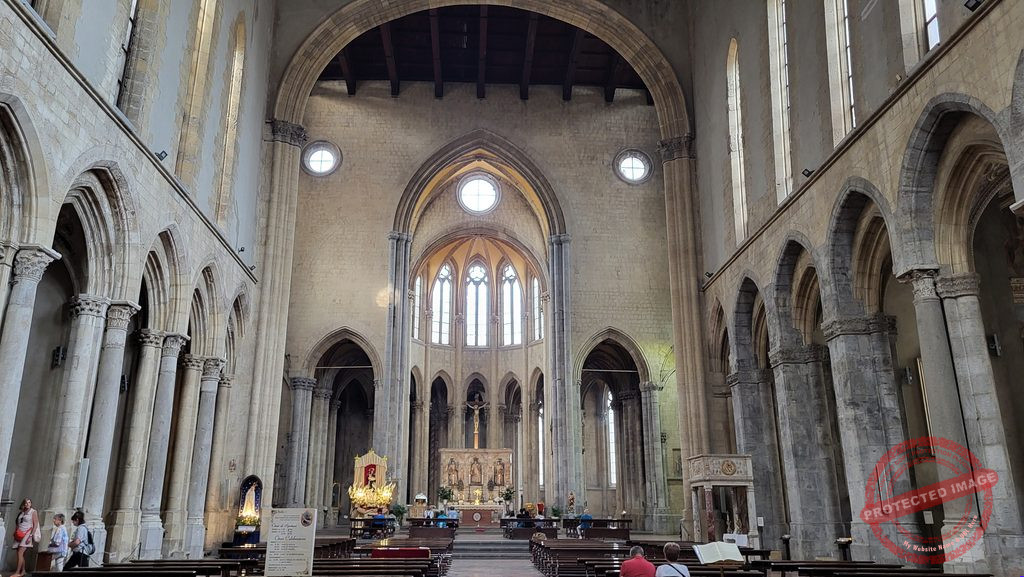
Just past the workshops, an archway leads to a small square and a Gothic basilica hiding behind a Baroque facade. From its cloister, where legend says Boccaccio, author of the Decameron, met the woman who inspired his poetry, a staircase takes you down into a Naples most visitors never see: Greek, Roman and medieval layers stacked one on top of the other. A little further on lies the city’s ancient agora, now one of the liveliest squares in the old town. But that’s something to discover on foot.
The full tour: 13 stops, with audio guide
San Gregorio Armeno is stop 9 of a walking route that starts at Castel Nuovo and ends at Piazza Dante, crossing the historic center in an order that saves you from backtracking. My guide, Do-it-yourself NAPLES with AUDIO GUIDE, gives you the story behind every stop. Read it, or put on your headphones and let the audio guide lead you from stop to stop, with the same route and the same order as the written text.
Getting the audio is easy: the paperback has a QR code you scan with your phone, and the Kindle edition includes a direct link. Either way, you can start listening as you walk.
Along the way you’ll also reach two hidden gems most visitors miss: the Roman theater and underground Naples.
👉 [Get Do-it-yourself NAPLES with AUDIO GUIDE on Amazon] Paperback and Kindle. Audio guide included.